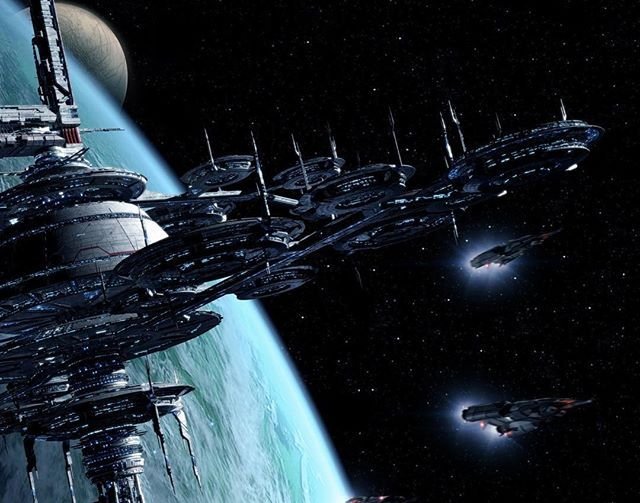
Dive into the sprawling cosmos of imagination, and you’ll quickly realize that science fiction isn't just about escaping reality; it's about exploring the very limits of it. From the mind-bending physics of warp drives to the profound implications of first contact, the genre serves as our intellectual frontier. This "Starships, Technology, & Alien Species Encyclopedia" isn't merely a collection of terms; it's a deep dive into the historical currents and philosophical tides that have shaped our understanding of the alien, the artificial, and the incredibly advanced. It’s an invitation to marvel at how authors and creators have continually pushed the boundaries of human invention and empathy.
At a glance:
- Aliens are more than just monsters: Their evolution in sci-fi reflects humanity's changing understanding of itself, from satirical figures to truly incomprehensible beings.
- Spaceships are vessels of dreams: They've transformed from fantastical projectiles to scientifically plausible rockets, then became symbols of escape, culture, and even intelligence.
- Technology is the genre's lifeblood: From impossible propulsion systems to sophisticated communication tools, it underpins every galactic adventure and alien encounter.
- Sci-fi often mirrors reality: Cold War paranoia, Darwinian evolution, and philosophical debates have all left their indelible mark on the worlds we imagine.
- The unknown remains compelling: Despite centuries of exploration, the fundamental questions about alien life and future tech continue to drive new narratives.
The Cosmic Tapestry: Understanding Alien Beings in Science Fiction
The idea of "aliens"—sentient beings from beyond Earth—is one of science fiction's most enduring and versatile concepts. Far from mere monsters, they’ve served as invaders, teachers, allies, enemies, or indifferent forces, reflecting our deepest fears and highest aspirations. Their forms range from human-like to utterly unimaginable, and their origins can be as diverse as outer space, other dimensions, or even unexplored parts of our own world.
Since the early 17th century, the serious consideration of alien intelligence has provoked existential questions, challenging human chauvinism and expanding our understanding of biology and society. Historically, the debate over life on other worlds dates back to antiquity, with philosophers like Epicurus and Lucretius affirming it, while Plato and Aristotle opposed it. The Copernican revolution and telescopic observations in the 17th-18th centuries reignited this debate, directly challenging humanity's perceived centrality in the cosmos.
From Humanoids to the Unimaginable: The Evolution of Alien Depictions
Early literary forays into cosmic travel, like Kepler's Somnium and Godwin's The Man in the Moone, often depicted extraterrestrial life as simply "men and animals" in peculiar forms, primarily for utopian or satirical purposes. True breakthroughs in depicting genuinely alien life—creatures shaped by adaptation to non-Earth environments—came much later, spurred by Darwinian Evolution in the late 19th century.
Camille Flammarion popularized this concept, sketching diverse biologies like sentient trees and silicon-based life. J.H. Rosny aîné pushed boundaries further with truly bizarre, evolution-based entities, such as geometric mineral lifeforms in Les Xipéhuz, showing remarkable empathy even in conflict. Perhaps most famously, H.G. Wells’s The War of the Worlds (1898) presented Martians not just as invaders, but as Darwinian competitors, using their genocidal intent to critique human colonialism and challenge imperial illusions.
The early US pulp era often simplified aliens into monstrous invaders or quasi-human inhabitants, with battles often ending in genocidal climaxes. Space opera, too, frequently resorted to symbolic good-vs-evil narratives, where, for instance, spider-like aliens were inherently nasty, and humanoids benevolent. However, even in this era, exceptions emerged. Stanley G. Weinbaum's "A Martian Odyssey" (1934) was a pivotal moment, introducing genuinely strange, non-anthropomorphic lifeforms like the intelligent Tweel, and a distinct Martian ecosystem that departed from typical pulp melodrama. Raymond Z. Gallun's "Old Faithful" (1934) further broke anthropocentric molds by showing intellectual kinship between humans and Martians.
The Post-War Shift: Communication, Paranoia, and Philosophy
After World War II, while alien-menace narratives persisted (think Campbell's shapeshifting assimilator in "Who Goes There?"), there was a growing sophistication. Reputable magazines explored complex communication with alien races, portraying these interactions as uneasy and multifaceted, as seen in Murray Leinster's "First Contact" (1945). Yet, some authors began to question the very possibility of communication with minds so profoundly different (Fredric Brown's "The Waveries," Robert A. Heinlein's "Goldfish Bowl").
The 1940s also marked a shift away from our solar system as the primary source of aliens, as scientific understanding rendered other planets increasingly inhospitable. This led to sophisticated depictions of nonhuman aliens adapted to extraordinary environments, such as those in Hal Clement's Mission of Gravity (1953), even if their thought processes often remained somewhat human-like.
The Cold War profoundly influenced alien narratives, giving rise to "paranoid" invasion plots where aliens mimicked humans or controlled minds (Heinlein's The Puppet Masters, Jack Finney's The Body Snatchers). This era also saw the emergence of benevolent, often superior alien figures, questioning humanity’s wisdom and fitness for galactic dominance (Arthur C. Clarke's Childhood's End). By the late 1950s, human-alien interactions had become commonplace, spanning from trade-motivated alliances to xenophobic militarism, as exemplified in Heinlein's controversial Starship Troopers.
Incomprehensibility and Cosmic Loneliness: Modern Alien Encounters
Eastern European sci-fi, notably Ivan Yefremov, often rejected the alien-menace trope, positing that truly advanced civilizations would be mature and non-militaristic. Stanisław Lem, however, took a darker turn, emphasizing the profound hopelessness of communication with alien beings in works like Solaris and Fiasko, often resulting in misunderstanding or accidental destruction. The Strugatski brothers' "Piknik na obochine" (Roadside Picnic) introduced aliens as indifferent "picnickers" leaving behind incomprehensible debris, a stark reflection of cosmic indifference.
The New Wave of the 1960s-70s often echoed this skepticism, using aliens metaphorically to challenge human self-importance and the limits of our understanding (Philip K. Dick, Ursula K. Le Guin). This era, coinciding with the decay of editorial taboos, also saw deeper explorations of sexual and psychological themes through alien figures.
While some writers continued to craft scientifically plausible alien biologies and cultures (Larry Niven's Known Space series), the 1970s and 80s also saw a resurgence of "contact hunger" influenced by SETI, with optimistic portrayals of beneficial alien contact (Carl Sagan's Contact). Films like Spielberg's Close Encounters of the Third Kind and E.T. beautifully captured this hope for alien salvation. Yet, Ridley Scott’s Alien (1979) sharply cut through this optimism, reintroducing the viscerally biological alien-as-monster, forever changing cinematic terror.
In recent decades, authors like Octavia Butler (Xenogenesis trilogy) have explored extreme, psychologically challenging hybridization, while others depict skeptical or problematic alien assistance. Superpowerful aliens are often relegated to the deep past, leaving behind mysterious ruins and artifacts that enable advanced technology like FTL travel (Frederik Pohl's Heechee series). The New Space Opera (1980s-present) presents vast interstellar communities with diverse human-alien interactions, sometimes involving complex political landscapes, as seen in Iain M. Banks's Culture novels.
However, a popular millennial motif is rapacious, implacable aliens bent on destruction, often machine intelligences (Fred Saberhagen's Berserker series) or biological plagues (Alastair Reynolds's Inhibitors), frequently serving as explanations for the Fermi Paradox—the unsettling silence in the cosmos. Meanwhile, quieter tales like Mary Doria Russell's The Sparrow explore the localized, individual impact of alien contact. The pervasive mood of cosmic loneliness continues to echo, emphasizing the vast, silent void and the profound strangeness that truly alien life might embody.
The Vessels of Destiny: The Evolution of Starships in Sci-Fi
If aliens are the characters that challenge our perceptions, starships are the stages upon which these cosmic dramas unfold. They are more than mere transportation; they are symbols of ambition, escape, and the human drive to explore the unknown.
The serious proposition of human space travel dates back to John Wilkins in 1638. Early literary cosmic voyages, such as Edgar Allan Poe’s “The Unparalleled Adventure of One Hans Pfaall” (1835), often lacked scientific rigor, using improbable balloons or atmospheric assumptions. Jules Verne’s De la terre à la lune (1865) famously launched a projectile, not a true vessel, to the moon, highlighting the early focus on the destination rather than the journey's mechanics.
From Fantastical Devices to Realistic Rockets: The Technological Leap
The late 19th and early 20th centuries saw spaceships often powered by mysterious, convenient forces like "Apergy" (Percy Greg, 1880) or "Cavorite" (H.G. Wells, 1901), frequently depicted as perfect spheroids or flying submarines. As sci-fi pulp magazines took hold, their visual imagery dramatically shifted. Spaceships became bulbous, resembling bloated aeroplanes or ocean liners, often adorned with decorative jets or fins. While initially serving as mere "facilitating devices," space opera quickly elevated them to symbols of unlimited opportunity and luxurious seclusion, akin to Earthly ocean liners like the Nautilus.
A significant turning point came in the 1930s when Hard SF writers embraced the rocket as the scientifically plausible basis for real spaceships. This spurred narratives of large-scale construction projects, like Lester del Rey’s "The Stars Look Down" (1940), reflecting a growing realism that foreshadowed actual space exploration. Today, with rocket launches a commonplace reality, the construction aspect is less central to most narratives, shifting focus instead to advanced propulsion and destination.
Beyond Transit: Generation Ships, Intelligent Vessels, and Cultural Icons
Robert A. Heinlein’s "Universe" (1941) introduced the archetypal Generation Starship, a self-contained world designed for multi-generational voyages. This concept became a powerful symbol of the Ark, representing permanent escape and the endurance of human civilization, pushed to its extreme in Poul Anderson's Tau Zero (1970), where a ship outruns the end of the universe. Spaceships also formed the basis of entire "starship cultures" (e.g., Heinlein’s Citizen of the Galaxy) and provided fertile ground for exploring relativistic time-dilation effects—a core technological challenge of interstellar travel.
Post-WWII UFO crazes influenced spaceship imagery, making disc-shaped craft common in illustrations and cinema. Later, sleek streamlined designs gave way to more bizarre and surreal forms, as authors understood that vessels built for the hard vacuum of space had no need for aerodynamic streamlining. Some authors imbued spaceships with romantic or even biological characteristics, such as Cordwainer Smith’s light-powered "sailing ships" or Jack Williamson’s tree-grown starships.
The anthropomorphic tendency to refer to ships as "she" evolved into literal intelligence. Human brains were transplanted into spaceships to create functional cyborgs (Anne McCaffrey’s The Ship Who Sang, 1969), or sophisticated computer networks gave ships distinct personalities, sometimes with delusions of grandeur or even split identities. Stanisław Lem’s Niezwyciezony (1964) explored the very mythology of spaceships, examining their role as instruments of exploration and conflict.
The charisma of spaceships endures, even for those serving as mere facilitating devices. Think of the iconic Enterprise from Star Trek, a vessel that embodies exploration, diplomacy, and cutting-edge TNG episode guide hub across countless alien encounters and technological advancements. The decline in plausibility for home-made spaceships in modern narratives often leads to the discovery of charismatic alien spaceships, sometimes serving sinister roles (Stephen King’s The Tommyknockers, 1988), or providing access to advanced alien technology, as seen in Frederik Pohl’s Gateway (1977). This enduring fascination even influenced reality, with public pressure leading to an experimental space shuttle being named "Enterprise" in 1977, cementing sci-fi’s influence on our collective dreams of space.
The Engine of Imagination: How Technology Drives Sci-Fi Narratives
While "technology" might not have a dedicated historical section in our ground truth, it is the invisible, yet ever-present, hand that shapes both starships and alien encounters. From the earliest dreams of flight to the most advanced concepts of FTL travel and artificial intelligence, technology is more than just a plot device; it's a character, a challenge, and a reflection of human ingenuity and folly.
Propulsion and Travel: Breaking the Light Barrier
The journey of sci-fi propulsion mirrors our growing understanding of physics. Early stories used fantastic, unexplained forces, allowing writers to focus on the destination rather than the mechanics. The recognition of rockets as realistic propulsion brought a sense of scientific rigor, but also imposed limits. This led to the invention of technologies like "warp drives," "hyperdrives," and "wormholes"—technological leaps necessary to truly explore the vastness of space without waiting for generations. These concepts aren't just about speed; they influence societal structures (how empires form, how isolated colonies develop) and the very nature of alien encounters (proximity, frequency, speed of conflict).
Communication and Understanding: Bridging the Gulf
Technology is also crucial in addressing one of the most profound challenges of alien contact: communication. Early narratives often assumed universal translators or instantly comprehensible alien languages. However, as sci-fi matured, the technological and philosophical complexities of communicating with truly alien minds became a central theme. SETI (Search for Extraterrestrial Intelligence) influenced optimistic narratives of deciphering signals, while others explored advanced linguistic analysis or even mind-to-mind links. The technological solution to communication often dictates the tone of a first contact story—from peaceful exchange to inevitable conflict arising from misunderstanding.
Artificial Intelligence and Sentient Machines: Companions, Servants, and Threats
The concept of artificial intelligence is deeply intertwined with both starships and alien species. We've seen starships with advanced computer networks developing distinct personalities, becoming intelligent entities themselves, sometimes even merging with human consciousness. But AI also appears as its own "alien" species—from the benevolent, guiding intelligences of some space operas to the terrifying, implacable machine intelligences, like the Berserkers, that pose existential threats to all biological life. These narratives often explore the ethical implications of creating sentient life, the nature of consciousness, and the potential for technological creation to surpass and even destroy its creators.
Shaping Worlds: Terraforming and Environmental Engineering
While not explicitly a starship or alien technology, environmental engineering, such as terraforming, is an implicit technological advancement critical to many sci-fi settings. The ability to transform barren planets into habitable worlds or adapt humans to alien environments showcases technology's power to conquer nature itself. Conversely, understanding how alien species have adapted to their own unique, often extreme, environments highlights the role of biology as a kind of organic technology, evolving solutions to survival.
Weaponry and Defense: The Tools of Conflict
Finally, technology plays a critical role in the conflicts that often arise between species. From ray guns and energy shields to planet-destroying superweapons and sophisticated defensive systems, the evolution of weaponry in sci-fi reflects both our fears of war and our hopes for ultimate security. Military sci-fi, in particular, showcases advanced tactics and weaponry, often pushing the boundaries of what's possible in interstellar warfare.
Navigating the Future: The Enduring Allure of the Unknown
The "Starships, Technology, & Alien Species Encyclopedia" reveals that the worlds of science fiction are never static. They are fluid reflections of our scientific understanding, our cultural anxieties, and our timeless fascination with what lies beyond. From the crude rockets of early imagination to the sophisticated, sentient starships of tomorrow, and from the anthropomorphic "men from Mars" to truly incomprehensible beings inhabiting hyper-dense atmospheres, the genre continuously evolves.
This exploration isn't just about cataloging tropes; it's about understanding the deep philosophical underpinnings of why we tell these stories. Why do we seek out alien life, even when it means facing our deepest fears? What does the pursuit of faster, more powerful starships say about our desire for knowledge, conquest, or escape? And how does the technology we imagine shape the futures we might build?
As you continue to delve into the vast literature and media of science fiction, remember that every alien, every starship, and every technological marvel is a carefully crafted lens. Through it, we don't just see strange new worlds; we catch glimpses of ourselves, our potential, and our place in the boundless cosmos. The journey continues, and the encyclopedia is just the beginning of your guide through it.